
Apache Kafka vs Confluent Kafka: Apache Kafka has become one of the most popular technologies for building real-time data streaming and event-driven applications. Organizations use Kafka to process millions of events per second, connect microservices, build data pipelines, and enable real-time analytics.
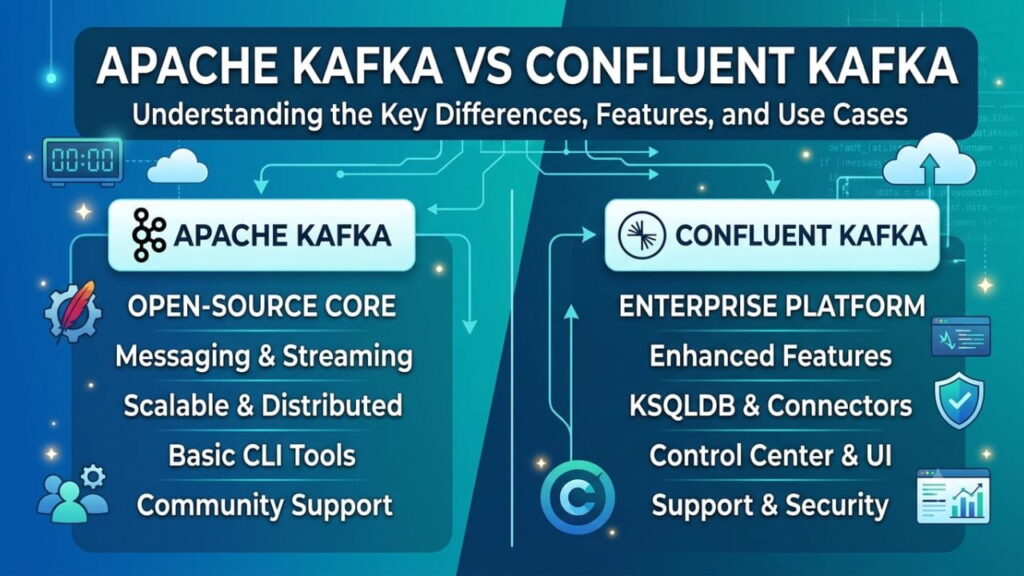
However, when developers begin learning Kafka, they often encounter another term: Confluent Kafka. This leads to a common question:
What is the difference between Apache Kafka and Confluent Kafka?
In this article, we will explore Apache Kafka and Confluent Kafka in detail, compare their features, understand their architecture, and determine which solution is best suited for different use cases.
Table of Contents
What is Apache Kafka?
Apache Kafka is an open-source distributed event streaming platform developed by LinkedIn and later donated to the Apache Software Foundation. Kafka was designed to handle large volumes of real-time data with high throughput, fault tolerance, and scalability.
Today, Kafka is widely used for:
- Event-driven architectures
- Microservices communication
- Real-time analytics
- Log aggregation
- Data streaming
- Change Data Capture (CDC)
- IoT data processing
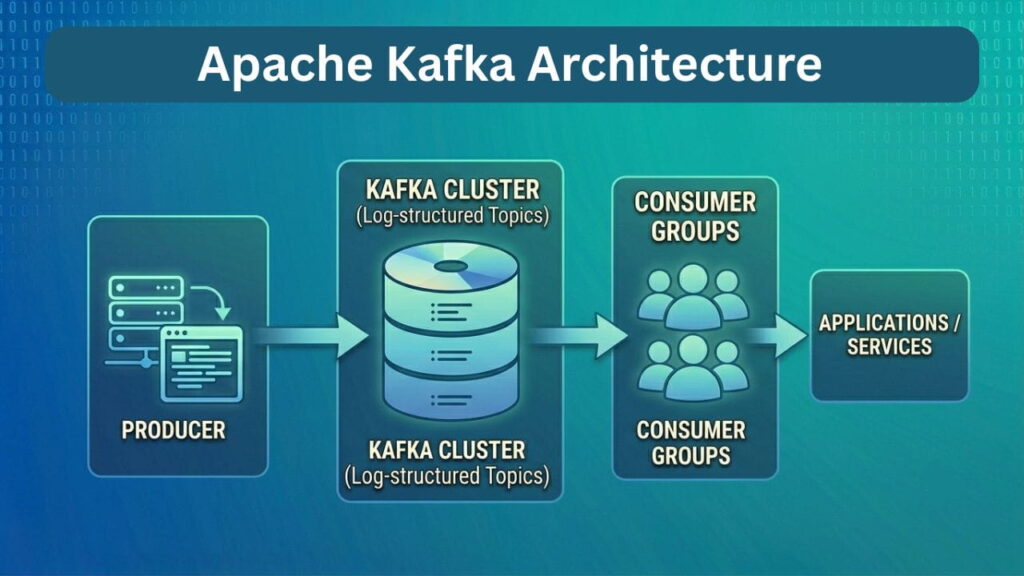
Core Kafka Components
Apache Kafka consists of several fundamental components:
Producer
Applications that publish messages to Kafka topics.
Example:
- Order Service publishes order events.
- Payment Service publishes payment events.
Consumer
Applications that read messages from Kafka topics.
Example:
- Email Service consumes order events.
- The Notification Service consumes payment events.
Topic
A logical channel where messages are stored.
Example:
order-created
payment-completed
user-registered
Partition
Topics are divided into partitions for scalability and parallel processing.
Broker
A Kafka server responsible for storing and serving messages.
Consumer Group
A group of consumers working together to process messages from a topic.
Apache Kafka Architecture
What is Confluent Kafka?
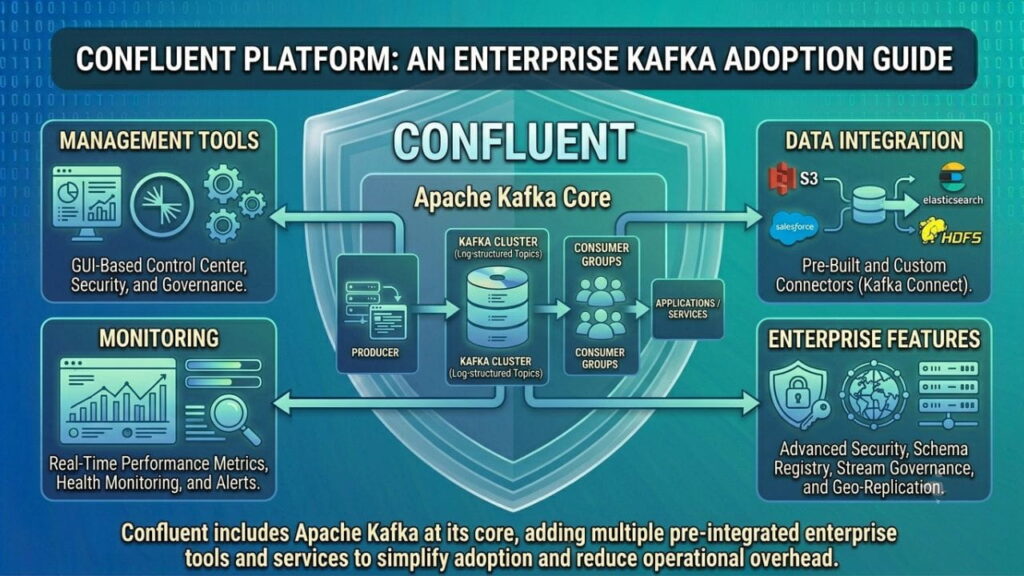
Confluent Kafka is not a different messaging system. Confluent was founded by the creators of Apache Kafka and provides a complete event streaming platform built around Apache Kafka.
Think of Confluent as:
Apache Kafka
+
Enterprise Features
+
Management Tools
+
Monitoring
+
Data Integration
Confluent includes Apache Kafka at its core but adds several additional services and tools that simplify enterprise adoption.
Why Was Confluent Kafka Created?
Although Apache Kafka is powerful, organizations often need additional capabilities such as:
- Schema management
- Monitoring dashboards
- Data integration tools
- Security enhancements
- Stream processing
- Cloud deployment
Building and maintaining these features separately can be complex. Confluent provides these capabilities out of the box.
Confluent Platform Components
Kafka Broker
The same Apache Kafka broker is used by the open-source project.
Schema Registry
Manages schemas for event data.
Supports:
- Avro
- JSON Schema
- Protobuf
Benefits:
- Data consistency
- Version control
- Backward compatibility
Example:
{
  "customerId": 1001,
  "customerName": "John"
}
Schema Registry ensures producers and consumers agree on the data structure.
Kafka Connect
Provides ready-made connectors for integrating Kafka with external systems.
Examples:
- MySQL
- PostgreSQL
- Oracle
- MongoDB
- Elasticsearch
- AWS S3
Without Kafka Connect, developers often need custom integration code.
ksqlDB
A SQL-based streaming engine for Kafka.
Example:
SELECT *
FROM orders
WHERE amount > 1000;
This allows real-time stream processing using SQL instead of Java code.
Control Center
A web-based UI for monitoring Kafka clusters.
Features:
- Topic monitoring
- Consumer lag tracking
- Cluster health monitoring
- Message throughput metrics
Apache Kafka does not include such a dashboard by default.
Confluent Cloud
A fully managed Kafka service.
Benefits:
- No infrastructure management
- Automatic scaling
- Managed upgrades
- Built-in monitoring
Apache Kafka vs Confluent Kafka
| Feature | Apache Kafka | Confluent Kafka |
|---|---|---|
| Open Source | Yes | Yes (Core Kafka) |
| Kafka Broker | Yes | Yes |
| Schema Registry | No | Yes |
| Kafka Connect | Basic | Enhanced |
| ksqlDB | No | Yes |
| Monitoring Dashboard | No | Yes |
| Managed Cloud Service | No | Yes |
| Enterprise Security | Limited | Advanced |
| Commercial Support | Community | Professional Support |
| Pre-built Connectors | Limited | Extensive |
| Easy Administration | Moderate | Easier |
Advantages of Apache Kafka
- Completely Open Source: No vendor dependency.
- Lightweight Deployment: Only the required Kafka components are installed.
- Large Community: Extensive documentation and community support.
- Flexible Architecture: Developers can choose third-party tools for monitoring and management.
Advantages of Confluent Kafka
- Faster Development: Ready-made enterprise tools reduce development effort.
- Better Monitoring: Control Center provides visibility into cluster operations.
- Easier Data Integration: Hundreds of connectors are available.
- Enterprise Support: Organizations receive commercial support and SLAs.
- Stream Processing: ksqlDB enables SQL-based event processing.
When Should You Use Apache Kafka?
Apache Kafka is a good choice when:
- Learning Kafka fundamentals
- Building personal projects
- Creating small-to-medium applications
- Operating with limited budgets
- Requiring complete open-source solutions
Examples:
- Spring Boot learning projects
- Personal microservices applications
- Internal development environments
When Should You Use Confluent Kafka?
Confluent Kafka is ideal when:
- Running enterprise applications
- Managing large Kafka clusters
- Requiring schema governance
- Integrating multiple external systems
- Needing advanced monitoring
- Using managed cloud infrastructure
Examples:
- Banking systems
- E-commerce platforms
- Financial trading systems
- Telecom applications
- Large-scale event-driven architectures
Docker Images for Apache Kafka and Confluent Kafka
Apache Kafka
Official image:
docker pull apache/kafka:latest
Specific version:
docker pull apache/kafka:4.2.0
Confluent Kafka
Official image:
docker pull confluentinc/cp-kafka:latest
Specific version:
docker pull confluentinc/cp-kafka:8.2.0
Which One Should Spring Boot Developers Choose?
For learning Kafka concepts:
Apache Kafka
For production-ready microservices:
Confluent Kafka
For enterprise event-driven systems:
Confluent Kafka
For lightweight development environments:
Apache Kafka
Common Misconceptions
Myth 1: Confluent Kafka Is Different From Kafka
False.
Confluent uses Apache Kafka as its core messaging engine.
Myth 2: Apache Kafka Is Outdated
False.
Confluent itself is built on Apache Kafka.
Myth 3: Confluent Replaces Kafka
False.
Confluent extends Kafka with additional tools and services.
Conclusion
Apache Kafka and Confluent Kafka are closely related technologies, but they serve different needs.
Apache Kafka provides a powerful, open-source event streaming platform suitable for learning, development, and custom implementations.
Confluent Kafka builds upon Apache Kafka by adding enterprise-grade capabilities such as Schema Registry, Kafka Connect, ksqlDB, monitoring dashboards, security enhancements, and managed cloud services.
If your goal is to learn Kafka fundamentals or build small-to-medium applications, Apache Kafka is often sufficient.
If you are developing large-scale, production-ready microservices and event-driven systems that require governance, monitoring, integrations, and operational simplicity, Confluent Kafka offers significant advantages.
Want to revisit the lessons or explore more?
Return to the Apache Kafka Tutorial Home PageWhether you want to review a specific topic or go through the full tutorial again, everything is structured to help you master Apache Kafka step by step.